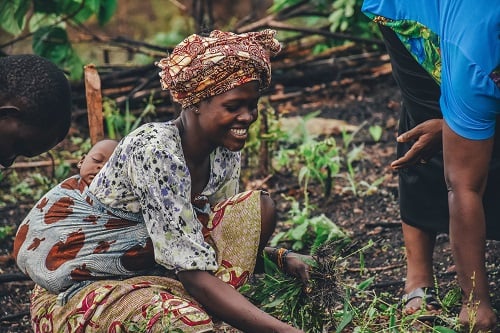
Agriculture is the backbone of the Sierra Leone’s economy, engaging over 70% of the workforce, with women making up the majority. Family-centered agriculture in Sierra Leone holds immense potential for driving economic growth and achieving food security, but farmers face a multitude of challenges, including limited access to modern tools and techniques, the adverse impacts of climate change, rising costs of inputs like seeds and fertilizers, inadequate infrastructure, and difficulties accessing fair markets.
President Julius Bio’s Feed Salone Initiative aims to revolutionize agriculture in Sierra Leone. Led by Dr. Henry Kpaka, Minister of Agriculture and Food Security, Feed Salone envisions a cultural transformation. in which agriculture becomes something that people are proud of again. Agriculture will only be sustainable when family farmers can get a decent livelihood from their work.
“Unlocking Africa’s agriculture potential would also unlock its development. Farming is Africa’s main livelihood: more than two-thirds of Africans depend on agriculture for their incomes. Investing in agriculture is one of the best ways to reduce poverty in Africa. According to World Bank analysis, growth in the agriculture sector is 2.5 times as effective at reducing poverty as growth in other sectors. . . .When connected to markets, smallholder farmers can generate an income and create a ‘multiplier effect’ – sending their children to school and stimulating the economy in order to help lift their community out of poverty for the long term. Crucially, if women farmers received equal investment, productivity in Africa could rise by more than 22%, meaning more produce for markets, more income for women and more food for children. (study by One.org source document)
The Ministry of Agriculture and Food Security and large organizations like the Food and Agriculture Organization of the United Nations address critical policy and infrastructure issues. We work to empower individual farming families, especially women and youth. In the past, we helped fund rice production in Tagrin and Tardi villages, honey production in Bombali, and Village Hope Innovation Farm in cooperation with Village Hope Inc. We helped farmers gain access to seed so they can farm their own land rather than working as day laborers on large commercial farms. We helped women start an onion business by providing them with a small grant to cover startup costs. We helped women get a mechanical cassava grater to enable them the process cassava more quickly and easily.
White Field Partners aims to facilitate small interventions that align with the Feed Salone Initiative and the United Nations Decade of Family Farming Global Action Plan. Large-scale interventions and resources are needed, but we believe that small-scale actions at the grassroots level can contribute significantly to transformation. We plan to award small grants to carefully vetted women or men to cover startup costs of agriculture initiatives such as rabbitry, purchase of farming tools, or purchase of seed and fertilizer.
When we gave Tity, a girl who had no family, a small grant to start a soapmaking business, she worked hard and made a profit. One of our Board members sent jewelry-making material so that a woman could make and sell jewelry, With the profits, she was able to expand her shop. Grant applications will be available soon.

Vision of the Global Action Plan
A world where diverse, healthy and sustainable food and agricultural systems flourish, where resilient rural and urban communities enjoy a high quality of life in dignity, equity, free from hunger and poverty. Family farming is essential to achieve this vision.
The plan has seven pillars. White Field Partners works to support these three pillars.
Pillar 2–Support youth and ensure the generational sustainability of family farming
Pillar 3–Promote gender equity in family farming and the leadership role of rural women
Pillar 6. Promote sustainability of family farming for climate-resilient food systems
We are currently exploring possibilities for rabbitry. Rabbits mature quickly and have a short gestation period, allowing for rapid production cycles. Rabbit meat is a high-quality, protein-rich food source that is easily digestible by people of all ages. Starting a rabbit farm requires minimal capital, and feeding costs can be reduced by supplementing commercial feeds with kitchen waste and local grasses. Rabbitry is a growing sector in Sierra Leone, and the market shows significant potential.


Subsistence farming is backbreaking work done with simple hand tools. Often a farmer doesn’t own tools, and has to borrow or rent them. The amount of land in production is limited by farmers’ time and energy. A lot of agricultural labor is done by women.
We never underestimate women. Just look what a group of determined women farmers accomplished. Imagine what a group of women could do if they had a small walk-behind tractor. That’s a dream for the future.